With the advancement of human analysis level, in order to adapt to the increased requirements for sample pretreatment, solid phase extraction (SPE) technology is significantly better than the traditional liquid-liquid extraction technology: convenient and environmentally friendly, good reproducibility, time-saving and labor-saving solvents, widely used in the environment, pharmacology, food, medicine, public inspection, import and export inspection in various fields.
principle
Using the difference in partition coefficients between the compounds in the sample under test and the background impurities in the different packing materials of the SEP column, the corresponding elution solvents are matched to separate the compounds from the impurities.
Uses:
◎ Enrichment of the sample to be measured
◎ Remove interfering impurities
◎ Alter the matrix of the sample under test to make it suitable for the needs of analysis
Composition and specifications
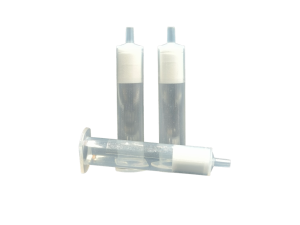
a. Common solid phase extraction columns are divided into three parts: medical polypropylene column tubing, porous polypropylene sieve plates (20 μm) and packing (mostly 40-60 μm, 80-100 μm)
b. Common specifications: 100mg/1ml, 200mg/3ml, 500mg/3ml, 1g/6ml, etc. are commonly used in practice. Take 100mg/1ml as an example, where 100 mg is the mass of the packing material and 1ml is the volume of the empty column tube.
c. Disposable: In order to avoid cross-contamination and ensure the reliability of the test, SPE columns are usually disposable.
Classification and Operation
form
Reverse phase extraction columns
Normal phase extraction columns
Ion exchange columns
procedure
Extraction of nonpolar samples from polar substrates
Extraction of polar samples from nonpolar matrices
Extraction of charged samples
revitalized
Rinse the column with 3-5 ml of methanol; rinse the column with 3-5 ml of deionized water (or buffer) and keep the column moist.
Rinse the column with 3-5 ml of non-polar solvent.
Rinse the column with 3-5 ml of deionized water (or low ionic strength buffer).
serve as model
Passing the sample through the extraction column at a suitable flow rate, the
The lower flow rate allows the sample to pass uniformly through the extraction column.
purge
Extraction columns eluting adsorbed samples with 5 ml of solvent of appropriate polarity (commonly pure water, buffer, water/organic solvent mixtures)
Elution of the extraction column with 5 ml of a suitable non-polar solvent for the adsorbed sample
5 ml of deionized water (or low ionic strength buffer) to rinse the column.
purge
The sample under test was eluted in batches with 5 ml of non-polar solvent into a collection vessel.
The sample under test, eluted in batches of 1-5 ml of polar solvent into a collection vessel.
The sample under test, eluted with 1-5 ml of high ionic strength buffer to the collection vessel
appliance
C18
Mainly used for reversed-phase extraction, suitable for non-polar to moderately polar compounds such as phthalazines, pharmaceuticals, dyes, aromatic oils, fungicides, herbicides, environmental pesticides, PAH and PCB residues, food additives, carbohydrates, p-hydroxytoluic acid-substituted lipids, phthalates, steroids, epigenetic activators…
C8
somewhat weaker than the nonpolar adsorption of C18.
C2
Relative to C18 and C8, because of the short chain, the retention effect is much smaller and suitable for non-polar compounds.
Silica
Extraction of polar compounds such as ethanol, aldehydes, amines, drugs, dyes, herbicides, pesticides, ketones, nitrogen-containing compounds, organic acids, steroids…
Phenyl
Weaker adsorption relative to C18 and C8, suitable for nonpolar to moderately polar compounds, especially benzenes.
Cyano-cn
Reversed-phase extraction: suitable for moderately polar compounds, normal-phase extraction: suitable for polar compounds such as aflatoxins, dyes, herbicides, steroids, weak cation exchange extraction: suitable for carbohydrates, cationic compounds…
Amino-NH2
Positive phase extraction: suitable for polar compounds, weak anion exchange extraction: suitable for carbohydrates, weak anions and organic acid compounds…
Acid Aluminum Oxide Alumina A
PH~5 Ion exchange and adsorption extraction of polar compounds
Basic Alumina Alumina B
PH~8.5 cation exchange and adsorption extraction
Alumina N-neutral
PH~6.5, polar compound adsorption extraction, PH regulation, cation and anion exchange, suitable for aromatic oils, enzymes, glycosides, hormones…
Magnesium silicate Florisil
Adsorptive extraction of polar compounds such as ethanol, aldehydes, amines, drugs, dyes, herbicides, pesticides, PCBs, nitrogen-containing compounds, organic acids, steroids…




Reviews
There are no reviews yet.